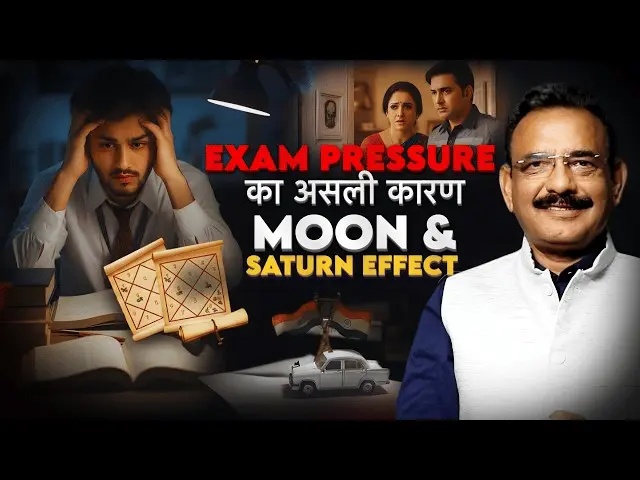
On exam day, it isn’t only children standing outside the school gate. Standing with them are their parents’ hopes, fears, comparisons, and everything left unsaid. The question paper arrives on the desk, but the real exam began long before that, in the living room, at the dinner table, in those moments when a mother goes quiet, and a father turns a little more serious.

According to Wing Commander Dr Santosh Sharma, a child fears the thought that quietly repeats inside them, “What if I can’t live up to their expectations?”, far more than any question in maths, science, or history. Their real exam isn’t about the syllabus at all. It’s about emotional approval. This guide explores how the emotional atmosphere of a home shapes a child’s studies, and how the Moon, Saturn, Mars, Rahu, and Venus each play a part, along with the remedies that genuinely help.

The Home Atmosphere Is Where the Pressure Really Lives

Exam season doesn’t officially begin when the datesheet goes up. It begins when the atmosphere at home slowly shifts. Conversations that were once casual now circle back to studies. The television volume is turned down. A focused seriousness enters the parents’ eyes.

All of this is natural, Dr. Santosh Sharma is quick to say. A parent’s love pulls them to look toward their child’s future; they want their child secure, spared struggle, respected in life. But this is precisely where a subtle emotional shift happens: concern born of love converts into fear. And when fear hangs in the air, the child’s nervous system picks it up.

Children don’t read words; they read energy. If there’s worry on a mother’s face and a slight hardness in a father’s tone, the child’s brain begins receiving a signal: the situation is serious, mistakes are not allowed.

The Science of Stress: Why a Calm Brain Learns Better

Here, Dr. Santosh Sharma brings in the biology, and it’s the heart of the whole piece. The human brain’s primary job is not learning; it’s survival. When the environment feels safe, the brain begins to absorb knowledge. When it feels unsafe, the brain shifts into protect mode, and the fight-or-flight system activates.

When a child repeatedly receives stress signals, the body releases cortisol. In an emergency, cortisol is useful, but when it becomes chronic, the memory system slows down. The hippocampus, the brain region that recalls memories, can be temporarily blocked. This is exactly why a child goes blank in the exam hall and says, “I studied everything, but I can’t remember it.” The problem there is not intelligence. It’s emotional overload.

And it deepens: overthinking sets in, and the child imagines the result even while studying. Their mind lives more in the future than the present, and a silent fear attaches itself to every page.

The Moon: The Child's Emotional Stability

Astrologically, Dr Santosh Sharma places this entire scenario under the Moon. The Moon signifies the mind; it governs emotions, comfort, and inner stability.

He offers a lovely image: the Moon is like water, taking the shape of whatever container it’s poured into. If the home is peaceful, the Moon stays calm. If the home is filled with fear, the Moon begins generating disturbed waves. The symptoms of a disturbed Moon in a child are clear: anxiety, crying without reason, self-doubt, disturbed sleep, and emotional withdrawal. The child feels they simply can’t study, but the truth is they’re carrying an emotional load that makes studying impossible. It isn’t inability; it’s overload.

Where the Parents' Stress Actually Comes From

Then Dr Santosh Sharma turns, with real compassion, to the parents, because their stress is transferred to the child. And a parent’s stress, he observes, is usually connected less to the child’s current performance and more to the parent’s own past.

If you’re a parent, understand this. You have seen struggles in your own life: financial insecurity, limited opportunities, comparison, rejection, success that came late. From this rises a silent resolution: my child should never have to face what I faced. That resolution is born of love, but slowly it dissolves into fear. When you watch your child at the study table, you’re not seeing just that moment; you’re seeing their entire future, and a silent calculation runs: good marks mean a good college, which means a good career, which means a secure child. Somewhere in that calculation, a thin layer of tension enters your voice.

Saturn and Rahu: Responsibility and Comparison

Astrologically, this parental zone belongs to Saturn and Rahu.

Saturn is the planet of responsibility and long-term security. When balanced, it gives discipline. But when fear activates it, it keeps generating worst-case imaginings: “What if this chance is missed?” Rahu, meanwhile, brings comparison and the sense of a social race: other children are going to coaching, the competition is so high. To you, it feels practical, but to the child, that vibration becomes a silent emergency alarm. You push your child because you fear life’s unpredictability, but the child experiences that push as an emotional threat.

Mars: Why the Air at Home Turns Hot

A third planet is at work: Mars. Why does the atmosphere at home sometimes turn hot? When Saturn’s pressure and Rahu’s comparison combine and make the home environment heavy, Mars energy ignites.

Mars is the planet of action, but when it’s imbalanced, it brings impatience and irritation. A parent’s tone sharpens. The words may sound motivational, but the vibration is heated, and dialogue gradually turns from encouragement into command. The atmosphere feels slightly charged, as though every minute were a competitive exam. The child’s nervous system picks up this temperature. Their Moon is already unstable, and the heat of Mars begins to dry out that emotional surface. The child speaks less but feels more inside, and self-confidence quietly erodes. They try to study more, but grow more anxious as they do.

The Child's Real Inner Fear

At the centre of it all is the child’s deepest fear, and it isn’t the paper. It’s the thought: “I’ll disappoint my parents.” This creates guilt, and guilt carries a heavy vibration.

The child thinks, “My parents are sacrificing so much; if I don’t measure up…?” This thought disturbs both Rahu’s illusion and the Moon’s sensitivity. Study done under guilt cannot reach deep storage in memory, because the mind is in defensive mode. Worse, the child begins measuring their worth by their marks, and this becomes identity-level stress. And so, in the exam hall, high emotional stress triggers cortisol; the memory drawer won’t open, panic sets in, and panic slows recall further still. Afterwards, the child says, “I’d studied it all, but I couldn’t remember.” This is not failure. It’s the effect of overload.

The Solution: Emotional Safety Equals Planetary Balance

The way through, Dr. Santosh Sharma says, is simple in principle: emotional safety equals planetary balance. The solution lies in reducing pressure and increasing emotional safety. When a child feels safe, the brain enters learning mode. Each planet points to a practice.

The Moon needs peace, soft words, eye contact, reassurance. Jupiter, the guru, offers perspective, the reminder that life is not just one exam. Venus lightens the environment: a little laughter, some music, small breaks. Make Saturn a partner in discipline rather than a source of fear: “let’s make a schedule together,” rather than a warning. And Mars should be used as motivation, never as anger.

The One Sentence That Stabilises the Moon

Wing Commander Santosh Sharmaa says one sentence can instantly stabilise a child’s Moon: “Whatever the result, we love you.” Said to a child, this sentence gives their subconscious a sense of security. When security comes, the brain opens; when the brain opens, learning becomes natural.

Astrologically, this whole phase is about Moon stabilisation. The Moon doesn’t need loud motivation; it needs safety. If parents simply soften their tone, the child’s brain gets the signal, “I’m safe,” and as safety arrives, cortisol naturally falls. So the solution isn’t in shouting or forcing; it’s in softness. A mother’s gentle touch, a father’s calm presence- these are Moon remedies, and they should not be considered any less powerful than a mantra.

Venus, Saturn, and the Feel of the Home

When the home atmosphere becomes too dry, Venus is needed; Venus gives softness, comfort, and aesthetic harmony. Some light music, a smile, a shared cup of tea: these are Venus remedies. When the environment feels lighter, the nervous system resets, the mind refreshes, productivity rises, and guilt doesn’t.

And Saturn should be made a support, not a fear. Parents often, in the name of discipline, turn Saturn into fear, but Saturn’s higher form gives support. When parents sit and build a schedule with the child, Saturn gives stability; when parents only issue warnings, Saturn becomes fear. Saturn’s positive energy gives a child structure of time, without emotional weight.

What a Child Truly Remembers

Dr Santosh Sharma leaves parents with something worth holding onto. An exam result is temporary, but the emotional experience of that exam time is permanent. A child won’t remember how many marks they got in a subject, but they will always remember whether, in that moment, they were supported or only pressured.

Marks are written on a report card; emotional reactions are written on the subconscious, and the subconscious is the foundation of future confidence. When a home’s atmosphere is filled with trust, softness, and acceptance, the child’s Moon is stable; a stable Moon brings clarity, and clarity naturally uplifts performance. Pressure may produce results, but it shrinks the personality. Safety produces the result and lets the personality blossom. That is why the real remedy, before the peace of the planets, is peace at home.

Frequently Asked Questions

How does the Moon affect a child’s studies?

The Moon governs the mind, emotions, and inner stability. When a child feels safe, their Moon stays calm, and the brain absorbs knowledge; when the home is fearful, the Moon is disturbed, bringing anxiety, self-doubt, disturbed sleep, and difficulty studying, even when the child is capable.

Why does a child go blank in the exam hall?

High emotional stress causes the body to release cortisol, which, in excess, temporarily blocks memory recall by slowing the brain’s hippocampus. The child panics, recall slows further, and afterwards they say they studied everything but couldn’t remember. It’s overload, not failure or lack of intelligence.

What roles do Saturn, Rahu, and Mars play in exam stress?

Saturn brings the pressure of responsibility and long-term security; when fear-driven, it imagines worst-case scenarios. Rahu brings comparison and social competition. Mars, when the atmosphere turns heavy, ignites impatience and a sharp tone, drying out the child’s already-unstable emotional state.

What is the best remedy for a child’s exam stress?

Emotional safety. Soft words, a calm tone, reassurance, and the message “whatever the result, we love you” stabilise the child’s Moon. A safe child learns naturally because the brain enters learning mode only when it feels safe. Like 2 mukhi rudraksha  (Moon), 6 mukhi rudraksha (Mars), 9 mukhi rudraksha (Rahu), and 17 mukhi rudraksha (Saturn) can be very supportive for both the child and parents. 

How can parents reduce the pressure they pass on?

By recognising that their stress often stems from their own past struggles rather than the child’s present. Making Saturn a partner (building a schedule together), using Mars as motivation, not anger, and adding Venus’s lightness, music, laughter, and small breaks keeps the home atmosphere supportive.

Does emotional support really improve exam performance?

Yes. A stable Moon brings clarity, and clarity naturally lifts performance. Pressure may produce results while shrinking the personality; safety produces results and lets the personality blossom. The emotional experience also shapes the child’s future confidence.