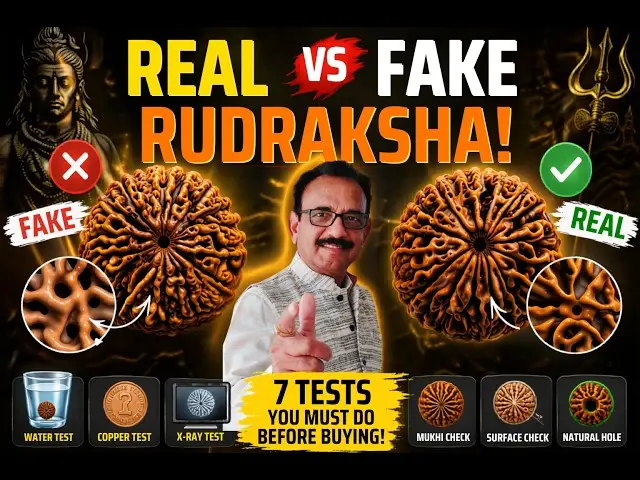
Rudraksha is one of the most powerful spiritual tools available to us, and it works genuinely well. When there is a blockage in life, or a dosha sitting in the horoscope, the right rudraksha can become a real source of support. But according to Wing Commander Dr. Santosh Sharma, all of this rests on a single condition: the bead must be genuine.

And here lies the problem. The market today is flooded with fakes, sold across countless websites and social media accounts, and many sincere people unknowingly become victims. Worse still, some of these fakes are not merely useless; they can actually cause harm. So before you wear a rudraksha for its benefit, it is worth understanding how to tell a real one from a false one. This guide walks through the popular tests that don’t actually work, the kinds of fakes to be careful of, and the reliable way to confirm that a rudraksha is authentic.

Why a Genuine Rudraksha Matters So Much

Let us be clear about why this matters. A rudraksha carries its power only when it is authentic. A genuine bead can help clear obstacles and strengthen the areas where your chart is weak. A fake offers nothing at all, and some fakes work quietly against your wellbeing.

This is why identification is not a small detail. It is the difference between wearing an authentic rudraksha that supports you and wearing something that, at best, does nothing and, at worst, harms you. Dr. Santosh Sharma’s whole intention here is to make you aware and to point you in the right direction.

The Water Float Test: Why It Does Not Work

The most popular test of all is the water test, and this is one Dr. Santosh Sharma openly and firmly disagrees with. You will have heard people say that a real rudraksha sinks and a fake one floats. He rejects this completely.

Understand what a rudraksha actually is. It is the fruit of a tree, and it carries a seed within it. When beads are harvested a little too early, while still slightly raw, they can sink in water. A fully formed bead, one whose inner chambers have developed properly and whose seed is well protected, may well float, and that does not make it fake at all. If anything, the bead that floats is often the properly formed one.

His verdict is direct: this test is essentially 50-50. It is neither scientific nor modern, and it is not a reliable test in any sense. Whether a bead sinks or floats tells you almost nothing about whether it is real.

The Coin Spin Test: Another Myth

The second myth is the coin test, where a bead is placed between two coins to see whether it rotates. Dr. Santosh Sharma calls this a game that proves nothing.

The reasoning people offer is that a rudraksha has a magnetic field. And it does, but that field is far too weak, made up of tiny microcurrents, to spin a bead between coins the way people claim. What truly moves the bead is pressure, your hand trembling ever so slightly, or a little unconscious pressure on the coins. It looks like something mystical is happening, but it is simply mechanics. As a test of authenticity, it is fundamentally mistaken.

Why Counting the Lines Can Deceive You

In older times, there were no laboratories, so people relied on counting the lines, the mukhis, running down the surface of the bead. A 15 Mukhi should show fifteen lines on the outside, and so on. It was a reasonable method for its time.

But today, Dr. Santosh Sharma cautions, this can be tampered with. There are extremely skilled artisans in our country, and just as fabric is crafted and passed off in the cloth trade, rudraksha can be worked upon in the same way. An extra line can be carved in, or a line can be quietly smoothed away, turning a 14 Mukhi into a 15, or a 16 into a 15, whatever demand and supply happen to favour. Two beads can even be joined together and sold as a Gauri Shankar. So counting the lines alone can easily lead you astray, and you may end up buying a fake while believing you have counted correctly.

The Dangerous Fakes: Bhadraksha and Poisonous Seeds

Some fakes go well beyond being useless; they become genuinely harmful, and here Dr. Santosh Sharma speaks with real seriousness.

One is Bhadraksha, which he has discussed separately, a bead that resembles rudraksha but is not rudraksha, and should never be used. More dangerous still are malas strung from the seeds of the ber (jujube) tree, or from poisonous forest seeds that look like rudraksha, dyed and sold as the genuine article. In traditional understanding, wearing such fakes can drain the body’s strength, and he warns they may contribute to ill health, confusion, or even depression. These cautions come from his experience and from traditional belief rather than from medical science, but the message is plain: a poisonous or false seed worn against the body is not a harmless little mistake.

Plastic beads are another matter altogether, harder to detect, often mass-produced, and sometimes even picked up from unclean places and then worn, unknowingly, as something sacred. So please understand, fakes are not only a waste of your money. Some of them carry real risk.

The Reliable Tests: Magnification, Hard-Boiling and X-Ray

So if the water and coin tests are only myths, what actually works? Here Dr. Santosh Sharma points to proper, laboratory-grade methods, the kind that confirm a lab-tested rudraksha with real confidence rather than folklore.

A magnification test, examining the bead under around twenty times magnification, reveals the fine details the naked eye simply cannot catch, and these days this can even be done by enlarging a clear image on a computer screen. A hard-boiling test can expose a joined bead: boil a supposed Gauri Shankar, and if it is two beads stuck together, they will eventually come apart, though this can take some time. And an X-ray test can reveal the internal chambers and the seed structure, confirming the true mukhi count from the inside out. These are the checks a genuine laboratory carries out, examining thousands upon thousands of beads until an expert can tell real from fake at a glance, much as an old, experienced goldsmith can judge gold the moment he sees it.

The Certificate: Your Real Proof, With One Catch

The most practical protection of all is a proper lab certificate, but Dr. Santosh Sharma is honest with you about one important catch.

Certificates themselves are widely faked. Some disreputable sellers simply tell a laboratory how many beads and how many mukhis they “need,” and false certificates are produced to match. Even the certificates of well-known laboratories have been forged; he has personally come across fakes in Bengaluru, Delhi, and other places. So a certificate on its own is not automatically proof.

The safeguard is verification. Every genuine certificate carries a document or unit number. You take that number to the laboratory’s own website, enter it, and confirm that the details match: the mukhi count, the width, the length, the origin, along with photographs of the bead from different angles. If the certificate is real, all of this will be waiting there online for you to check with your own eyes, and that verified match is what confirms you are holding an original rudraksha rather than a convincing imitation. If it cannot be verified against the laboratory’s own records, treat it with caution.

Who You Buy From Matters Most of All

Beyond every test and every certificate, the single greatest protection is buying from someone you can trust. Dr. Santosh Sharma urges you to look carefully into the background of your seller.

Ask who they are, where they come from, and whether they hold any genuine standing and respect in society, or whether it is simply a website opened to make quick money. A true seller usually has a purpose beyond profit, a wish to serve, a desire to walk the path of truth. Be wary of operations that display grand addresses in Mumbai, Delhi, or Kolkata but where no real person or premises can actually be found. Someone genuinely on the path of truth will speak truthfully to you; someone chasing only money will happily hand you a “set” fake with a bought certificate. So know your source, verify the certificate, and buy only from those whose reputation you can actually check.

Clearing the Fear and the Myths

Part of what makes this whole subject so confusing is the sheer amount of fear and misinformation spread around rudraksha, much of it, as Dr. Santosh Sharma points out, illogical and unscientific, meant to frighten people rather than to inform them.

The purpose of learning proper identification is to free yourself from both traps at once: the fakes on one side, and the fear-based myths on the other. Learn the reliable tests, verify the certificate properly, buy from a trustworthy source, and let go of the float-and-spin folklore. That is how you make certain the rudraksha you wear is genuine and truly working for you.

Frequently Asked Questions

Does a real rudraksha sink or float in water?

Neither reliably indicates authenticity. According to Dr. Santosh Sharma, a properly formed rudraksha can float because its inner chambers are well developed, while a raw or early-harvested bead may sink. The water test is essentially 50-50 and not reliable.

Is the coin-spinning test a real way to check rudraksha?

No. The bead’s magnetic field is far too weak to spin it between coins. What actually causes the movement is slight pressure or a trembling hand, so this test proves nothing about whether a rudraksha is genuine.

Can counting the mukhi lines confirm a real rudraksha?

Not on its own. Skilled fakers can carve in an extra line or smooth one away to alter the mukhi count, or join two beads together. Counting the lines alone can easily deceive a buyer.

What are the reliable ways to identify a genuine rudraksha?

The dependable methods are laboratory-grade: magnification at around twenty times, a hard-boiling test to expose joined beads, and X-ray to reveal the inner chambers and seed structure. These are the checks genuine laboratories rely on.

How do I verify a rudraksha certificate?

Every genuine certificate has a document or unit number. Enter that number on the issuing laboratory’s own website and confirm the details, mukhi count, dimensions, origin, and photographs match your bead. Certificates that cannot be verified online should be treated with suspicion.

Are fake rudraksha beads dangerous to wear?

Some can be. Beyond useless imitations, fakes made from ber seeds, poisonous forest seeds, or plastic may cause harm. In traditional belief, they can drain vitality and contribute to ill health, which is why a genuine bead from a trusted seller is strongly advised.