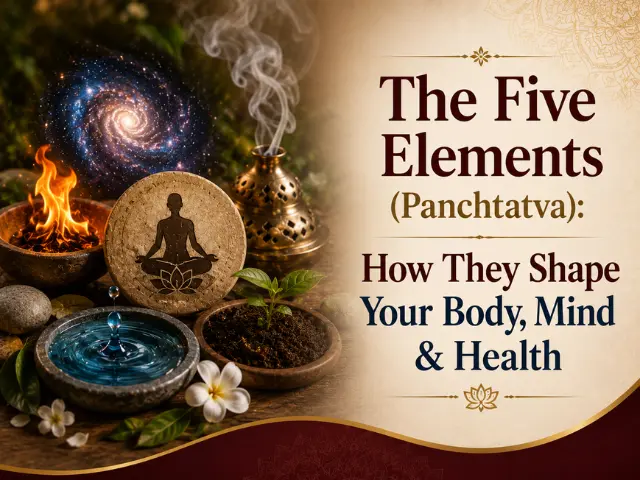
Whatever illness a person faces, whether of the body or of the mind, it arises from an imbalance in the five elements. This is where Wing Commander Dr. Santosh Sharma begins, and it’s a striking way to open, because it connects something as vast as the cosmos to something as personal as your own health.

The five elements, the Panchtatva, are earth, water, fire, air, and ether. Our entire physical body is built from them, and according to Dr. Santosh Sharma, when they fall out of balance, that is when problems, physical and mental alike, begin to appear. This guide explains what the five elements are, how they give rise to the three doshas of Ayurveda, and why keeping them in balance matters so much for wellbeing.

One honest note before we begin, in his own spirit of transparency: this is a spiritual and traditional framework for understanding the body and mind, offered to help you understand yourself, not a substitute for medical treatment.

What Are the Five Elements (Panchtatva)?

The Panchtatva are the five basic elements from which everything is made, including the human body: earth (prithvi), water (jal), fire (agni), air (vayu), and ether or space (aakash).

These are not merely abstract ideas. In this understanding, they are the very raw material of the physical body itself. Every part of us is some combination of these five. When they are held in balance, the body and mind function well, and we feel healthy. When that balance is disturbed, difficulties begin, and this is where the concept of the tridosha enters.

The Earth Element (Prithvi Tatva)

Earth is the element of solidity, structure, and foundation. It is the densest of the five, the one that gives the body its physical form, its bones, its stability, its grounding.

Just as the earth beneath our feet holds everything steady, the earth element within us provides the sense of being rooted and secure. Where it is strong and balanced, there is stability and endurance. Where it is weak or in excess, that steadiness is disturbed.

The Water Element (Jal Tatva)

Water is the element of fluidity, flow, and emotion. It governs everything that moves and flows within the body, and it carries a naturally emotional, sensitive quality.

Dr. Santosh Sharma associates the water element with the Moon and Venus, the planets he links to emotion, softness, and flow. Water gives life its adaptability and its feeling; an imbalance here tends to show up in the emotional and fluid aspects of our nature.

The Fire Element (Agni Tatva)

Fire is the element of heat, transformation, and digestion. Its most familiar expression in the body is the jatharagni, the digestive fire of the stomach, which is why fire is so closely associated with the Sun.

This is the element that transforms, that burns, that converts food into energy and intention into action. When the inner fire burns cleanly, digestion is strong and so is drive and willpower. When it is disturbed, both the body’s digestion and the mind’s sense of strength can suffer.

The Air Element (Vayu Tatva)

Air is the element of movement, force, and circulation, and Dr. Santosh Sharma’s explanation of it is worth following closely.

The lungs are air. The heartbeat, that constant dhak-dhak, is governed by air. When the air element becomes agitated, the heartbeat quickens; when it settles, the beat slows, and blood pressure eases. Blood pressure, the pulse, the circulation of blood, the forces that carry it downward through the body and up to the brain- all of these are forces, and forces are born of air. Air is what sets everything in the body into motion.

The Ether Element (Aakash Tatva)

Ether, or space, is the subtlest of the five elements. It means emptiness, that which contains nothing and yet holds everything.

Dr. Santosh Sharma offers a beautiful image for this: emptiness is what makes existence possible. This room can hold curtains and furniture only because it was first empty enough to be filled. The earth, the moon and stars, the planets and constellations, all exist because there was space for them to occupy. Within that vast emptiness lies the storehouse of all knowledge, and to access and understand it, the ether element must be in good order. Where ether becomes strong, he says, a person can begin to understand the cosmos itself, and to understand themselves, because we too are a part of that same cosmos.

How the Elements Create the Tridosha

Here is where the five elements meet health directly. In Ayurveda, imbalance among the elements gives rise to the three doshas, vata, pitta, and kapha, and Dr. Santosh Sharma maps them cleanly onto the elements.

When there is an imbalance involving the earth and water elements, it produces kapha, linked in the nadi system to the ending nadi. When the imbalance involves the water and fire elements, it produces pitta, a fiery temperament, linked to the middle nadi. And when the imbalance involves the air and ether elements, it produces vata, linked to the beginning nadi.

These three, vata, pitta, and kapha, are what influence both body and mind. In this understanding, every illness, whether physical or mental, traces back to an imbalance among the five elements that create it. Restore the balance of the elements, and you restore the balance of body and mind together.

Why Balancing the Five Elements Matters

The deeper message here is that health is not a collection of separate parts but a single, connected whole. Your physical body, your emotions, and your mind are all expressions of the same five elements, arranged in different proportions.

When earth, water, fire, air, and ether are in harmony, the body is well, the mind is steady, and there is a natural sense of well-being. When one element runs to excess or falls short, the effects ripple through both body and mind as a dosha imbalance. Understanding your own elemental nature, and what tends to disturb it, is therefore one of the most useful foundations for looking after yourself, from the inside out.

Frequently Asked Questions

What are the five elements (Panchtatva)?

The Panchtatva are the five basic elements from which the body and everything else is made: earth (prithvi), water (jal), fire (agni), air (vayu), and ether or space (aakash). Balance among them is considered essential for good health.

How do the five elements affect health?

According to Dr. Santosh Sharma, the entire physical body is built from the five elements, and imbalance among them is the root of illness, both physical and mental. Keeping them in balance supports the wellbeing of body and mind.

How do the five elements connect to the tridosha?

Imbalance in earth and water produces kapha, imbalance in water and fire produces pitta, and imbalance in air and ether produces vata. These three doshas influence both the body and the mind.

Why is the air element linked to the heartbeat and blood pressure?

Because the lungs and the heartbeat are governed by air, and blood pressure, pulse, and circulation are all forces which arise from the air element. When air is agitated, the heartbeat quickens, and when it settles, the beat and blood pressure ease.

What does the ether element represent?

Ether (aakash) represents space and emptiness, the vast openness that makes all existence possible. It is the subtlest element, linked to knowledge, self-understanding, and the ability to comprehend the cosmos.

Is balancing the five elements a substitute for medical treatment?

No. This is a spiritual and traditional framework for understanding body and mind. It can offer valuable insight and support, but it is not a replacement for proper medical care when it is needed.