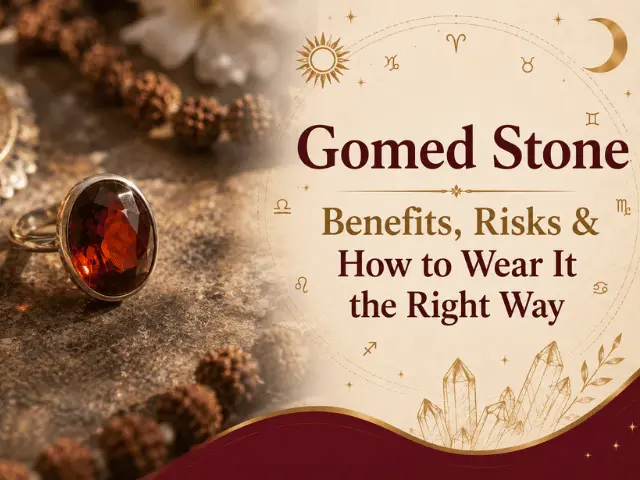
Gomed, the Hessonite stone, is one of the most powerful gemstones in Vedic astrology, and precisely because of that power, one of the most dangerous to wear carelessly.
According to Wing Commander Dr. Santosh Sharma, wearing Gomedh without proper astrological consultation can prove genuinely harmful. The reason lies in the planet it represents: Rahu, the illusory, shadow planet. Used rightly, Rahu can take you abroad, connect you with powerful people, and lift you to great heights. Used wrongly, its stone can create confusion and chaos in a life. This guide explains what Gomed does, who should and shouldn’t wear it, how to wear it correctly, and the serious cautions attached to it.
Why Gomed Is Considered So Powerful, and So Risky
Gomed’s power comes entirely from its ruling planet. Rahu is a mayavi, illusory planet, capable of clouding the mind, creating confusion, and in extreme cases, driving a person to abandon their home.
When Rahu is well placed, the same energy is transformative: it can carry you to foreign lands, help you connect with influential and powerful people, and even push you toward leadership or politics. But when Rahu sits in the wrong place in a chart, its stone can do real damage. If Rahu occupies the seventh house of marriage, for instance, its stone can strain or break a marriage. In the fifth house, it may relate to pregnancy complications. This is exactly why, in Dr Santosh Sharma’s view, no Rahu-related stone should ever be worn without astrological guidance first.
What Makes Gomed Different from Other Stones
Gomed is a honey-brown, honey-orange stone, and its colour is part of what makes it tricky. It can sometimes be confused with Ruby, and its appearance causes more uncertainty than most stones.
Its defining quality is how sharply its effects swing between benefit and harm depending on Rahu’s placement. There is very little middle ground with this stone, which is why it demands more caution than almost any other gemstone.
Who Can Benefit from Wearing Gomed
When Rahu is favourably placed, Gomed can bring notable benefits, and Dr. Santosh Sharma outlines several situations where it may help.
It can raise a person politically and lift them to high positions. It can build strong connections with powerful people abroad, the kind who run embassies and operate in influential foreign circles. For those in export or import businesses, the stone can bring considerable benefit. It has also traditionally been used in cases of repeated miscarriage, and where relationships and office life are being torn apart by conflict while Rahu sits in the seventh house, it may be used as a remedy. But in every one of these cases, the same condition applies: it must be worn correctly, or not at all.
Who Should Not Wear Gomed
The single most important rule is this: if Rahu is not well placed in your chart, you should not wear Gomed.
In certain specific situations it may still be worn, but only with proper astrological advice, and often on the opposite hand. Simply knowing that Gomed is Rahu’s stone and putting it on is not free of danger. Worn improperly, on the wrong finger, at the wrong time, without checking the chart, it will harm rather than help. The stone does not forgive guesswork.
How to Wear Gomed the Right Way
For those who are advised to wear it, Dr. Santosh Sharma gives a precise method.
Set the stone in a silver ring, not gold. Wear it on the middle finger, the same finger used for Neelam. Put it on during a Saturday, after sunset once darkness has fallen, facing the south direction, while chanting the Rahu mantra Om Raam Rahave Namah. The presiding deity of this stone is Goddess Chhinnamasta, and worshipping her is said to bring greater benefit. The fuller Rahu mantra may also be recited during the process.
The Serious Cautions With This Stone
This is the part that must not be skipped. Dr. Santosh Sharma is emphatic that Gomed carries risks unlike gentler stones.
Traditionally, it is warned that the stone should never be worn touching the body. Worn near the chest, it is said to risk heart trouble and increased palpitations; worn near the liver, it is said to affect the liver. These are cautions rooted in traditional belief rather than medical fact, but they are the reason he insists the stone be set and worn correctly rather than pressed against the body.
There are also opposing stones that must never be combined with Gomed. If you wear Rahu’s Gomed on the middle finger, you cannot wear the Sun’s Ruby (Manikya) on the ring finger, nor Pearl (Moti) on the little finger, nor Emerald (Panna). These are hostile combinations.
The most dangerous of all is one people sometimes attempt: setting Rahu’s Gomed and Saturn’s Neelam together in a single ring on the middle finger. This creates what is called Pishach Yoga, also known as Shrapit Yoga, a combination that can pull a person into problems so confusing they cannot understand why their life has taken such a turn.
Important Considerations Before You Wear It
A few further points matter. If Rahu is genuinely unfavourable but the stone must be used, it is worn on the opposite (left) hand, on the middle finger, to neutralise and reduce Rahu’s harmful effects; this can also apply in cases of Kaal Sarp Dosha.
Watch for warning signs after wearing it. Headaches or other bodily discomfort may indicate a flaw in the stone or a problem in your energy alignment. If the honey-orange stone shows a milky appearance, tradition holds it should be removed and replaced. Minor surface marks may not be an issue, but with a stone as powerful as Rahu’s, there is no reason to take the risk; if something looks wrong, remove and change it. Worn on the right hand, it is said to harm; worn on the left, it is considered safer.
There is also the matter of dasha. If you are running the mahadasha of the Sun, Saturn, or the Moon, all considered opposing to Rahu, wearing this stone during those periods is said to cause harm. This is why gemstones must always be chosen against the full picture: dasha, mahadasha, antardasha, pratyantar dasha, Kantaka Shani, Ashtama Shani, Janma Shani, and more.
Clearing the Confusion
Many misconceptions surround this stone, and the whole purpose of understanding it properly is to be free of them. Gomed is not a stone to wear on a friend’s suggestion, an internet article, or a general rule of thumb.
If you’re considering it, the safest path is a proper reading that checks Rahu’s placement, your running dasha, and the specific problem you’re trying to solve. When sourced, it should be an unheated, untreated stone suitable for astrological use. But the stone comes second. The chart comes first.
Frequently Asked Questions
Who should wear a Gomed (Hessonite) stone?
Gomed may benefit those with a well-placed Rahu, particularly people in export-import business, those seeking foreign connections or political rise, and certain specific situations, but only after proper astrological consultation confirms Rahu’s placement in the chart.
Who should not wear Gomed?
Anyone whose Rahu is unfavourably placed should avoid Gomed, as it can harm rather than help. It should also not be worn during the mahadasha of the Sun, Saturn, or the Moon, which are considered opposing to Rahu.
How should Gomed be worn correctly?
Traditionally, Gomed is set in a silver ring and worn on the middle finger on a Saturday after sunset, facing south, while chanting the Rahu mantra Om Raam Rahave Namah. Goddess Chhinnamasta is its presiding deity.
Which stones should not be worn with Gomed?
Gomed should not be combined with Ruby (Sun), Pearl (Moon), or Emerald. Setting Gomed and Neelam (Saturn) together in one ring is especially dangerous, as it is said to create Pishach Yoga, also known as Shrapit Yoga.
Why is Gomed considered a dangerous stone?
Because it represents Rahu, a powerful and illusory planet. When wrongly placed or wrongly worn, its effects can swing sharply toward harm, including relationship and health-related problems in traditional belief, which is why chart analysis is essential before wearing it.
What does it mean if my Gomed develops a milky appearance?
Traditionally, a milky appearance in the stone is taken as a sign that it should be removed and replaced. With a stone as powerful as Rahu’s, most advise not taking any risk and changing it promptly.